
TikTok Translate: How to Use Souldub to Translate Short Videos into More Languages
Every day, a large number of interesting videos appear on TikTok. Some videos come from creators' real experiences, some explain products, knowledge, travel, and lifestyle, and many pieces of content quickly gain attention in the local market because they are well-paced and naturally expressed. But when creators want to publish content to more countries, language often becomes a new barrier. Videos originally made well in Chinese, Thai, Japanese, or Korean may be incomprehensible to audiences in another market, making it difficult for them to fully understand the information in the videos.
How to Use Souldub to Do TikTok Translations, So More People Can Understand Short Videos
Every day, a large number of interesting videos appear on TikTok. Some videos come from creators' real experiences, some explain products, knowledge, travel, and lifestyle, and many pieces of content quickly gain attention in the local market because they are well-paced and naturally expressed. But when creators want to publish content to more countries, language often becomes a new barrier. Videos originally made well in Chinese, Thai, Japanese, or Korean may be incomprehensible to audiences in another market, making it difficult for them to fully understand the information in the videos.
I have recently been organizing a workflow for translating TikTok videos and found that what is truly effective tiktok translate should not just be replacing subtitles with another language. For creators, it should help a video enter new language markets; for users, it should turn an overseas video they originally couldn't understand into content they can watch naturally. This is also the reason I started trying to use Souldub to handle TikTok videos: preserving the original video’s visuals, rhythm, and expressions, and then transforming the video into a version more suitable for the target language audience through subtitle translation, AI dubbing, and human review.
Why TikTok video translation is not just about replacing subtitles
The viewing speed of short videos is very fast, and users usually do not stop to read a large block of subtitles word by word. If the original video's voice, subtitles, and visual information are not well coordinated, viewers need to constantly switch between 'watching the visuals, reading the subtitles, and guessing the tone.' Especially for tutorial, product introduction, and story videos, much important information is not only in the text but also in the speaking rhythm, emphasis, and context.
Simply adding subtitles is of course the easiest way, but it doesn't necessarily make the video feel as natural as native content. Sentence length, word order, and spoken expressions can vary between languages. If the subtitles in the target language are too long, they can block the visuals; if you only do literal sentence-by-sentence translation, the content may sound stiff. A more complete TikTok video translation requires handling subtitles, dubbing, timing, and the final video, while also allowing room for manual review.
As a creator: Let a TikTok video enter more language markets
Why do publishers need multilingual versions
For creators and brands, a well-performing TikTok video often already validates the content theme, visual rhythm, and expression style. What really needs to be addressed is not necessarily re-shooting, but how to bring this video to more people who can understand it.
For example, a Thai creator shares skincare product usage methods in Thai, and the video receives great engagement locally in Thailand. Later, they want to try the English-speaking market. If they rewrite the script, find English presenters, arrange recording and editing, the whole process would take a lot of time; if they only add English subtitles, overseas users might quickly scroll past due to the reading burden. With Souldub, creators can upload the completed original video, convert the Thai voice into English dubbing, and simultaneously generate a subtitle version suitable for English-speaking audiences.
Multilingual videos do not automatically guarantee traffic growth, but they give content the opportunity to be understood in more search, recommendation, and sharing scenarios. For product accounts, educational accounts, travel creators, and brands going global, the same content can be produced in English, Spanish, Chinese, Japanese, Korean, and other versions based on market needs, and then published on the corresponding accounts or channels. The value of doing this is not just increasing views, but it can also bring more followers, inquiries, orders, and advertising revenue.
Use Souldub to complete pre-release multilingual localization
Creators can first upload the original TikTok video, then select the original language and the target language. Souldub will recognize the voices in the video and generate editable subtitle text. Next, creators can check proper nouns, product names, brand slogans, and key expressions, and then generate AI dubbing in the target language.
Before publishing, I usually focus on checking these areas:
-
Whether the brand name, product name, and feature name in the video are consistent;
-
Whether the expression in the target language sounds like something a real user would say, rather than a literal translation;
-
Whether the speed, pauses, and emotions of the AI dubbing match the rhythm of the original video;
-
Whether the subtitle length is suitable for the mobile screen, and whether it covers the product or person;
-
Do the key selling points appear simultaneously with the visuals and voiceover?
-
Whether the CTA is suitable for the target market, such as Learn more, Try it now, or Get started;
-
Whether the multilingual versions retain the humor, tone, and narrative focus of the original video.
The actual process from upload to release
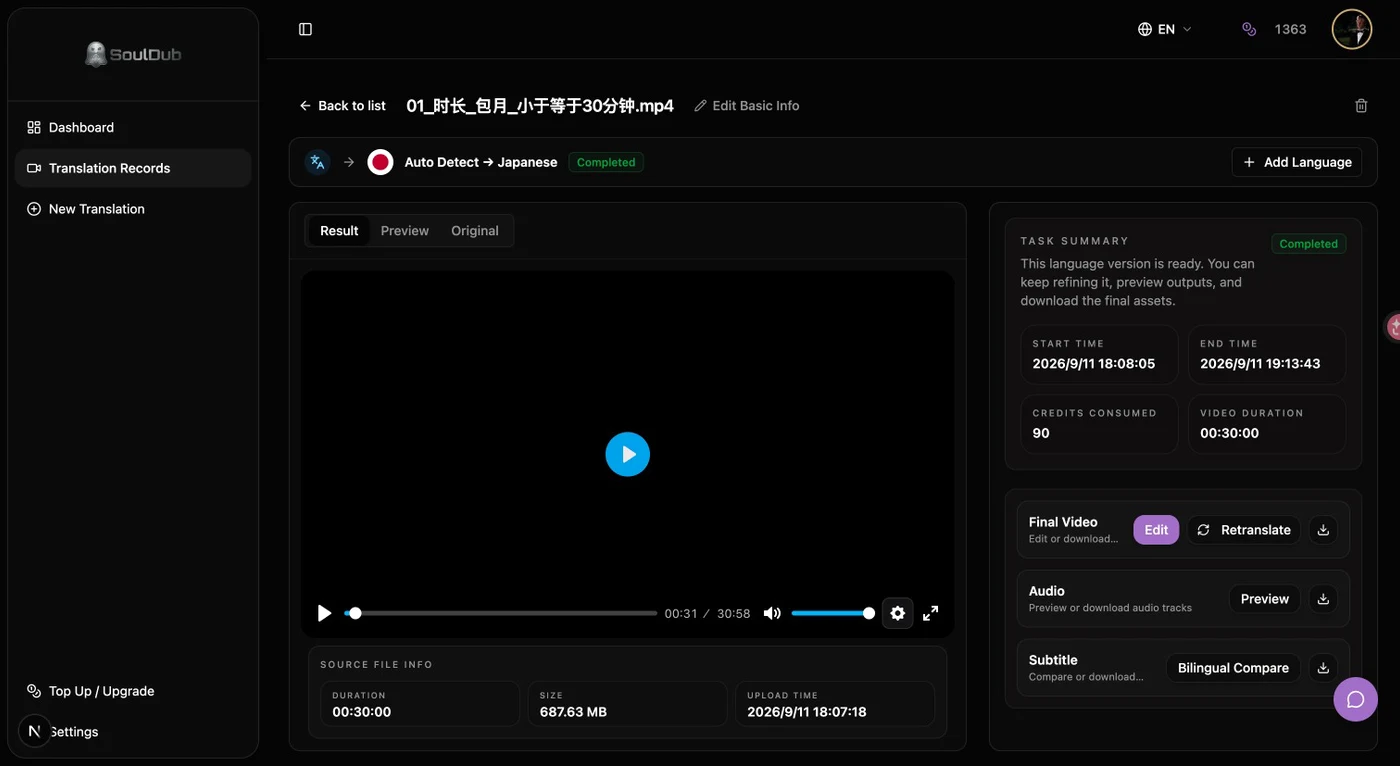
Step one, prepare a TikTok video that has already been edited. It is recommended to prioritize videos with clear visuals, clean audio, and verified interaction performance. Step two, upload the video to Souldub and set the source language and target language. Step three, generate translated subtitles and check names of people, places, products, and industry terms. Step four, generate AI voiceover and adjust according to the number of speakers, audio tracks, and video rhythm. Step five, preview the final effect in the workspace and review the subtitles and voiceover line by line. Finally, export the target language version, and then publish it according to different markets with appropriate titles, tags, and release times.
If a video needs to target multiple markets, you can continue adding languages in the same task, without having to start over for each language version. This not only makes it easier to compare expressions in different languages but also allows the team to manage versions and subsequent edits more easily. For creators who continuously release content, this is more stable than having to find translators, voice actors, and editors on the fly each time.
How multilingual publishing helps traffic and revenue
TikTok's recommendations and search rely on whether users are willing to continue watching, interacting, and sharing. Audiences who can directly understand the content usually find it easier to watch the video to the end and are more likely to grasp the main points of the product or story. For accounts with commercial goals, these changes may further affect homepage visits, private message inquiries, product clicks, and collaboration opportunities.
More importantly, multilingual versions can help creators test new markets. You can first select one to three of the best-performing videos, create English or other target language versions, and then observe completion rates, engagement rates, and conversion feedback. If the content performs better in a certain market, you can further expand the language range and posting frequency. In this way, TikTok Translate is not just a translation action, but a low-cost way to validate overseas content demand.
As a user: Convert TikTok videos you don't understand into your native language
What should I do if I come across an overseas video I like but can't understand?
Another type of demand comes from ordinary viewers. Many people come across videos from overseas creators every day: it could be a very practical photography tutorial, an introduction to a travel destination, a product review, or an explanation of knowledge they are interested in. But when the video is in English, Thai, Japanese, Korean, or other languages, even if the visuals are very appealing, they might miss the key points because they cannot understand the language.
If the platform provides a download function, or you have obtained authorization from the video creator, you can save the video locally and then upload it to Souldub, choosing the language you are familiar with as the target language. Souldub will generate translated subtitles and target language dubbing based on the voices in the video, turning content that could originally only be watched into a version that can be fully understood.
It is important to note here: when downloading and processing TikTok videos, one should comply with TikTok's platform rules, copyright requirements, and the scope of authorization from the creator. This article discusses videos that users are entitled to download, save, and process. TikTok is a trademark of its rights holders, and Souldub has no affiliation or official cooperation with TikTok.
What is the difference between subtitle translation and dubbing translation?
If the video content is relatively short, or the surrounding environment is not suitable for playing sound, you can generate subtitles in the target language first. Subtitles can help users quickly understand the main information of the video and are also suitable for scenarios where the original audio needs to be preserved.
If the video is a tutorial, interview, knowledge sharing, or story content, dubbing in the target language usually sounds more natural. Users do not need to pause to look up words or continuously look down at subtitles, allowing them to focus more on the visuals and the explanation itself. For videos with fast speech and a large amount of information, using dubbing together with subtitles will result in better comprehension.
How can a user complete a translation
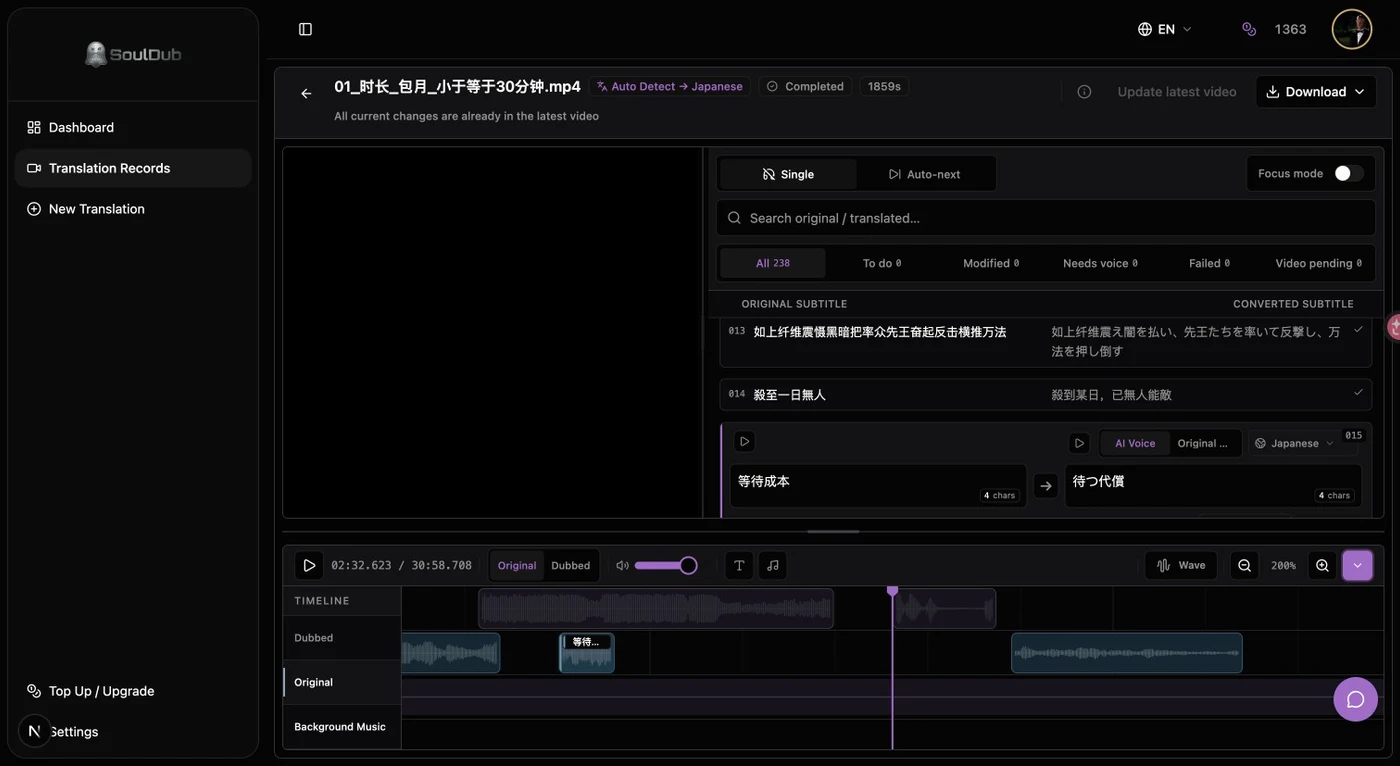
Step one, prepare a TikTok video that you have the rights to handle. Step two, upload it to Souldub and select the video's original language, or let the system automatically recognize it. Step three, choose the native language you want to use to generate translated subtitles and AI dubbing. Step four, check proper nouns, numbers, dates, and people's names on the editing page. Step five, preview the video, make sure the subtitles do not block the visuals and the dubbing is not noticeably out of sync, then export or continue editing.
Which overseas TikTok videos are suitable for handling this way
These types of TikTok video translations are especially suitable for the following content:
-
Overseas product reviews and unboxing videos;
-
Travel guides, city introductions, and food recommendations;
-
Photography, editing, fitness, and DIY tutorials;
-
Technology, software, and artificial intelligence knowledge sharing;
-
Interviews, stories, and documentary-style short videos;
-
Content about language learning and cultural introduction.
If you just want to quickly know what the video is about, you can first generate subtitles; if you plan to study seriously, take notes, or watch repeatedly, you can further generate dubbing in the target language. For longer videos, you can also first select the segments you are most interested in and, after confirming the translation effect, then process the full content.
After translating, it is still necessary to do a check.
AI video translation can save a lot of time, but it doesn't mean that every word doesn't need to be checked. Especially professional terms, slang, puns, place names, and personal names may need to be modified in context. Viewers can adjust the subtitles on Souldub's editing page, or compare the original audio and the target language version to ensure that the translation has not changed the core meaning of the original video.
This step also applies to creators. Whether it is publishing videos to overseas audiences or converting overseas videos into the native language, the final quality depends on whether the translation is accurate, the dubbing is natural, and the subtitles are synchronized with the visuals. AI is responsible for speeding up the process, while manual review is responsible for turning the results into truly watchable and publishable content.
Why Souldub is Suitable for TikTok Video Translation
TikTok videos are often short, fast, and information-dense. When translating, it is necessary to pay attention to the voice, subtitles, and timeline simultaneously. Souldub integrates uploading, speech recognition, subtitle translation, AI dubbing, subtitle editing, video preview, and version management into a single task workspace. Both creators and viewers can continue to make edits after the results are generated, rather than only being able to accept a one-time automatic output.
For creators, it can convert completed content into multiple language versions, helping videos enter new markets; for users, it can translate foreign videos they do not understand into their own language, lowering the barrier to understanding content. Although the two needs seem different, the underlying process is very similar: upload the video, choose the language, generate the translation, check the results, and then export the video for further use.
Frequently Asked Questions
Can TikTok Translate translate videos into Chinese?
Sure. As long as the video contains content you have the right to handle, you can upload it to Souldub, select the original language and Chinese as the target language, and generate Chinese subtitles and Chinese AI dubbing.
Is it possible to translate a TikTok video into multiple languages?
Sure. Creators can add multiple languages based on their target markets and check the subtitles, voiceovers, and final video versions separately. It is recommended to start with videos that have good interaction and gradually test the feedback from different markets.
I just want to understand the video, I don't need to repost it, can I still use it?
Sure. Users can generate only subtitles, or generate target language dubbing at the same time. Once processing is complete, it can be previewed in the workspace and exported for personal understanding and learning use.
Can TikTok videos be used directly for commercial release after translation?
Whether it can be published depends on the copyright of the original video, the author's authorization, and platform rules. Translation tools cannot replace copyright permission. For content intended for commercial use, please first confirm that you have the corresponding rights to download, adapt, and publish it.
Ending
The value of TikTok Translate is not just to change a sentence into another language, but to allow the information, sounds, and emotions in videos to continue being understood by more people.
For creators, they can start with a well-performing video and use Souldub to generate English, Chinese, Thai, Japanese, or other language versions, then continuously optimize it based on viewing and interaction data from different markets. For users, when encountering overseas videos that they are interested in but cannot understand, they can also, on the premise of having legal usage rights, convert them into their native language through subtitle translation and AI dubbing.
When creators are able to publish multilingual content in familiar ways, and viewers can understand foreign videos in their own language, the spread of short videos is no longer limited by a single language. Souldub can connect these two directions: allowing content to reach more markets and enabling more people to understand the content they are truly interested in.
By
Sugar Vale(舒格·维尔)
Souldub content experience consultant, long-term focus on video localization, AI dubbing, and cross-language content growth.


